


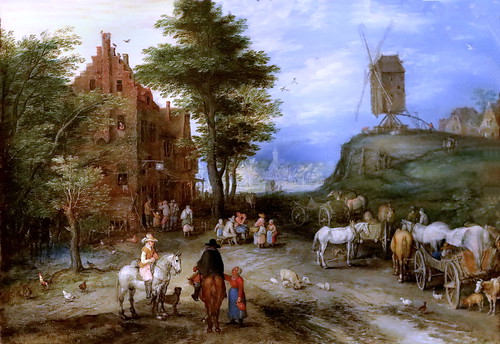
IMG_1533D Jan Brueghel I 1568-1625 Anvers Entrée d’un village avec un moulin à air vent Entry to a village with a windmill c 1605 Zürich Kunsthaus Huile sur cuivre
Jan Brueghel I 1568-1625 Anvers
Entrée d’un village avec un moulin à air vent
Entry to a village with a windmill c 1605
Zürich Kunsthaus
Huile sur cuivre
PAYS BAS: LA PEINTURE DE LA SOCIÉTÉ CONTEMPORAINE.
Une des caractéristiques parmi les plus remarquables de la peinture des Pays Bas du Nord, protestants, qui domine tout le 17è siècle, le siècle d’Or hollandais, est la peinture de genre, la peinture de la vie quotidienne, la description fidèle, réaliste et matérialiste de toute la société contemporaine des peintres.
Non seulement la société aristocratique, comme dans les pays du sud de l’Europe, en Allemagne ou en Angleterre, mais aussi celle bourgeoise, small bourgeoise, et même celle artisanale et paysanne.
La peinture de paysage qui est une autre des caractéristique de l’école néerlandaise entre d’ailleurs en réalité dans la summary par les artistes de la société du temps. Le paysagisme néerlandais est la peinture par les artistes néerlandais de l’environnement de la société dans laquelle ils vivent.
Et même quand ils font le trip d’Italie, les paysages italiens peints par les artistes néerlandais sont habités non the same level des Dieux, des Déesses ou des héros antiques, mais par des numbers humaines ou animales de leur temps. Les artistes néerlandais ne peignent pas des paysages avec Io transformée en vache, ou Zeus métamorphosé en aigle, mais des bovins et des aigles tout à fait ordinaires.
Partout ailleurs en Europe occidentale l’art religieux, l’art mythologique, l’art historique, ce que l’on appelle “” le Grand Art” “domine. La peinture de style, des moeurs de la société est en comparaison proclaim à fait anecdotique et la peinture de paysage est essentiellement un staff put les thèmes religieux, historiques ou mythologiques qui forment le sujet principal du tableau.
Ces positionings générales, particulières aux Pays Bas du Nord, néerlandais, ont deux origines:
1) Idéologiques: la Réforme.
Rappelons quelques dates qui sont des jalons importants.
La Séparation de fait des Pays Bas du Nord et du Sud: 1579 (Union d’Utrecht).
La Reconnaissance définitive de l’indépendance des Pays Bas du Nord the same level tous les pays européens: 1648.
La Réforme néerlandaise, de tendance calviniste, limite l’iconographie religieuse à la représentation du Christ en croix et supprime toute représentation imagée de Dieu, du Saint Esprit, des Anges, de la Vierge, des Saints, du Diable. C’est en réalité la disparition de la peinture religieuse comme thème de l’art de la société. Les artistes ont donc été dans l’obligation de trouver d’autres sujets de peinture, qui soient tolérés par la nouvelle élite idéologique et politique et qui intéressent leurs customers. Ces sujets seront donc inspirés par la société du temps, dans toutes ses composantes sociales, et par l’environnement paysager. L’incidence de la Réforme sur le picture est aussi importante: l’aristocratie se fait discrète, au earnings de la grande bourgeoisie d’affaires et même de la tiny bourgeoisie artisanale ou commerciale. C’est la peinture des “” Gueux” appellation qui avait child origine dans les Pays du Sud mais que les révoltés du Nord avaient revendiquée et adoptée comme caractéristique de leur révolte contre l’Espagne et le Catholicisme romain.
2) Historiques et culturelles:
L’art de la Réforme calviniste néerlandaise ignore tous les sujets tirés de l’histoire et de la mythologie gréco-romaine. Les Pays Bas du Nord n’ont jamais été colonisés par Rome et l’empreinte culturelle de l’Antiquité y est donc très discrète. Beaucoup plus faible qu’en Allemagne, malgré les parentés ethniques et linguistiques et malgré le fait qu’une grande partie de l’Allemagne ait aussi échappé à la colonisation romaine. L’ Empire Germanique a précocement et longtemps dominé l’Italie, il a donc assimilé la culture de l’Antiquité Gréco-Romaine. Cet empire s’ est d’ailleurs appelé pendant des siècles ” “le Saint Empire Romain Germanique””, appellation très révélatrice des influences méditerranéennes sur la Germanie. Influences inexistantes aux Pays Bas du Nord. Ce ce sont ces différences culturelles que leur art pictural respectif reflète très bien, malgré les proximités ethniques et linguistiques.
Cet intérêt put le quotidien, ce réalisme naturaliste et matérialiste est cependant déjà très présent dans les Pays Bas du Sud flamands, don’t la populace est de même origine ethnique et de même langue que celle des Pays Bas du Nord. Pourtant les Pays Bas du Sud sont d’anciennes colonies romaines, l’empreinte catholique y est profonde et ils sont restées catholiques.
C’est ce que démontrent, parmi d’autres artistes, deux peintres emblématiques, Bruegel Pierre I (1525-1569) et Brueghel Jan I (1568-1625). Il est possible de constater chez ces peintres des Pays Bas du sud catholiques, postérieurs à ceux que l’on appelle les “” Primitifs Flamands””, mais actifs avant que la Réforme ait pu produire tous ses effets guides ou indirects, une tendance très nette à traiter les sujets religieux comme un theme parmi d’autres, dans des tableaux qui component put l’essentiel une peinture de la société du temps ou des paysages de l’époque. Les thèmes du Carnaval ou des Proverbes sont même totalement profanes, ils sont manifestement l’occasion de peindre la société contemporaine de l’artiste.
C’est déjà aussi ce que l’on observe chez un peintre d’Anvers, très antérieur et qui constitue un autre jalon idéologiquement très vital de la peinture des Pays Bachelor’s degrees: Joachim Patinier, Patenier, ou Patinir (1483 1524).
La comparaison avec l’art des pays européens du sud met en évidence une inversion des valeurs subtiles mais profondes: La Vie ou la Enthusiasm du Christ, la Vie de la Vierge, la vie de tel ou tel saint comme Jérôme ou Jean Baptiste ne sont plus le sujet principal du tableau, même quand le titre invoque le thème religieux. Ils sont un détail, (on n’ose pas dire un prétexte) dans une peinture très détaillée, très populaire, très réaliste, de la vie quotidienne. Ou, dans le cas de Patinir, dans une peinture do not la lyrique, put ne pas dire la mystique, est essentiellement paysagère.
THE NETHERLANDS: THE PAINTING OF CONTEMPORARY SOCIETY.
One of one of the most remarkable features of Protestant paint in the North Netherlands, which dominated the 17th century, the Dutch Golden Era, is genre paint, painting of day-to-day life, the faithful, realistic and also materialistic description of the entire contemporary culture of painters.
Not only the aristocratic society, as in the nations of southerly Europe, Germany or England, however additionally the bourgeois, petty bourgeois, as well as even the artisanal and also peasant society.
Landscape painting, which is another feature of the Dutch college, is actually part of the artists’ summary of the society of the time. The dutch landscap is the paint by dutch artists of the atmosphere of the society in which they live.
And also when they take a trip from Italy, the Italian landscapes repainted by Dutch musicians are lived in not by ancient Gods, Goddesses or heroes, however by human or animal numbers of their time. Dutch artists do not paint landscapes with Io changed right into a cow, or Zeus changed into an eagle, but quite ordinary cattle and eagles.
Anywhere else in Western Europe spiritual art, mythological art, historic art, what is called “” Great Art” “dominates. Sex paint, social mores remains in comparison quite anecdotal and landscape painting is basically a structure for the spiritual, historical or mythical styles that create the main topic of the painting
These basic standards, particular to the Dutch North Netherlands, have 2 origins:
1) Ideological: the Reformation.
Allow us remember some dates that are crucial landmarks.
The de facto splitting up of the Netherlands from the North and also South: 1579 (Union of Utrecht).
The definitive recognition of the freedom of the North Netherlands by all European countries: 1648.
The Dutch Reformation, with a Calvinist propensity, limitations religious iconography to the depiction of Christ on the cross and subdues all photographic depiction of God, the Holy Spirit, Angels, the Virgin, the Saints, the Adversary. It is really the loss of spiritual paint as a style of the art of culture. The musicians were as a result required to discover various other subjects of paint, which were tolerated by the brand-new ideological and also political elite and which interested their clients. These topics will for that reason be inspired by the society of time, in all its social components, and by the landscape atmosphere. The impact of the Improvement on the picture is likewise important: the upper class is coming to be very discreet, to the advantage of the industry bourgeoisie and also the small craft or industrial bourgeoisie. It is the painting of the “” Gueux” (the Beggars), appellation which had its beginning in the South yet which the rebels of the North had actually claimed and also embraced as an attribute of their rebellion versus Spain and Roman Catholicism.
2) Historical and also social:
The art of the Dutch Calvinist Improvement ignores all the topics drawn from Greek-Roman history as well as folklore. The Northern Netherlands has actually never ever been conquered by Rome as well as the cultural imprint of antiquity is for that reason really discret. Much weaker than in Germany, despite ethnic and also linguistic resemblances and the reality that a huge part of Germany additionally ran away Roman emigration. The German Realm dominated Italy early and for a very long time, so it assimilated the culture of the Greco-Roman Antiquity. For centuries, this realm was called “”the Divine Roman Realm of Germany””, a name that discloses the Mediterranean impacts on Germania. Non-existent impacts in the North Netherlands. It is these cultural differences that their respective photographic art shows quite possibly, despite ethnic and also linguistic proximities.
This rate of interest in day-to-day life, this naturalistic as well as materialistic realistic look is however currently really present in the Flemish Southern Netherlands, whose populace is of the very same ethnic origin as well as language as that of the Northern Netherlands. Yet the Southern Netherlands are previous Roman swarms, the Catholic footprint is deep and also they have stayed Catholic.
This is demonstrated, to name a few musicians, by two characteristic painters, Bruegel Pierre I (1525-1569) and Brueghel Jan I (1568-1625). It is feasible to observe amongst these painters from the Catholic Southern Netherlands, after those called the “”Flemish Primitives””, however energetic before the Reformation had been able to create all its straight or indirect results, an extremely clear propensity to deal with religious subjects as one concept amongst others, in paints that basically make up a painting of the society of the moment or landscapes of the moment. The styles of Circus or Adages are also totally nonreligious, they are certainly an opportunity to paint the artist’s modern culture.
This is currently what can be observed in an Antwerp painter from the very initial start, who stands for one more essential ideological landmark in Dutch paint: Joachim Patinier, Patenier or Patinir (1483-1524).
Comparison with the art of southerly European countries reveals an inversion of subtle however extensive worths: The Life or Passion of Christ, the Life of the Virgin, the life of such and also such a saint as Jerome or John the Baptist are no more the main topic of the paint, even when the title invokes the religious theme. They are a detail, (one does not dare to claim a pretext) in a very detailed, preferred, very realistic paint of everyday life. Or, in the instance of Patinir, in a painting whose lyricism, if not mysticism, is essentially landscape.
By jean louis mazieres on 2019-10-06 10:17:42
< img alt="tags" src="https://nu-rmal.com/wp-content/uploads/2020/11/mZ3t8M.jpg"/ >